Friday, January 22, 2010

Boulders! Ruins! Hampi!

First I want to mention with sadness the death of a former colleague on Tuesday. Evadne Sutherland was one of my favourite people at the Lifesaving Society Ontario Branch office, and I'll really miss her.

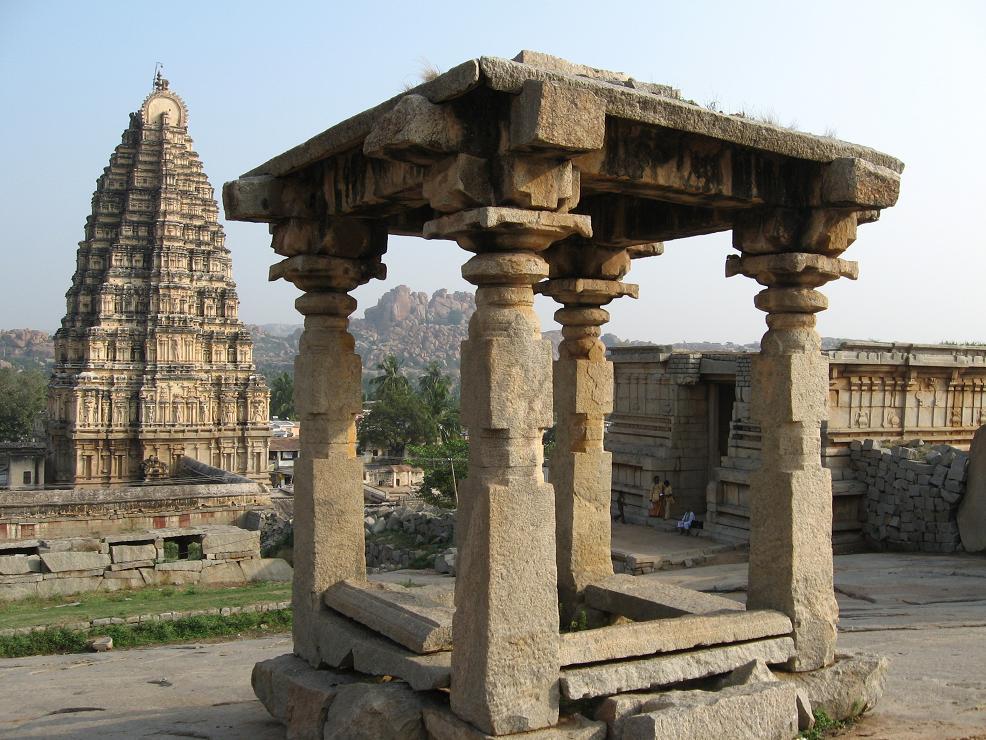
At Hampi in the state of Karnataka the surrounding monuments are included in the UNESCO World Heritage Site list. More than 550 ruins are here, and it's easy to share the builders' view of the sacred, clearly present in the landscape. The capital of the Vijayanagar empire, according to the epic Ramayana, lies in the historical home of the monkey people. They feature on many of the carved pillars. I've included one pillar of Hanuman, the monkey king, kicking some butt.

The best views of Virupaksha Temple, founded in the 7th century and dedicated to Shiva, are from Hemakuta hill to the south. Temple ruins are scattered among the boulders, and carvings were chiseled directly into the stone.


To the north is the Tunghabadra River, where coracles cross to the ruins and villages on the other side. They were building a bridge, but it fell down.


Inside Vittala Temple is a famous carving of a chariot which is a shrine itself.


One of my favourite sites was the stepped tank fed by an aqueduct. Here I captured a few of the hundreds of school children who wanted to say hello, ask my name, and have their photo taken. They're about to swarm me!


The Elephant Stables are inside the Zenana. It was difficult to capture how grand they are!


I walked around behind the stables to the quieter temples, and took photos of some beautiful working girls who were cutting the grass.


Nearby is the Lotus Mahal, a summer palace for the queen.


The temple architecture was really interesting. Often the base was of stone carved from the boulders littering the landscape, while the spires were built from brick, with painted stucco decoration. South Indian culture has some major historical differences from North Indian culture, and one difference arises in the iconography. This detail is from the Krishna temple. The Laxmi Narasimha monolith was also new to me--and fascinating! This is Vishnu in his man-lion incarnation, worshipped mostly in the south.

The final day I went for puja at Virupaksha temple. As always, you must remove your shoes to enter a temple. I included this photo of the central shrine from behind three nandi because I stood in something disgusting to take it. Including it in my blog makes me feel like it was worth it!


Then I rented a bicycle and cycled around at my own pace. I recommend this method of exploring most highly. Just make sure you get a bicycle with a seat that stays up! I visited the Underground Temple, and the Queen's Bath; only the Octagonal Bath made the cut in for the now-common Facebook B-list.

Saturday, January 9, 2010

Happy New Year!

Happy new year to all my old and new friends!

To celebrate the new year I travelled just outside of the city to the Big Wheels Motoring Club party. Lots of fun with friends, a huge dance floor outdoors, and a partial eclipse on a blue moon. Here are some photos of the fun with me, Yogesh, and Dhruv; Anita and Kishor; Neha and Shona; and Dhruv and Yogesh again with Vijay. I also unexpectedly met my former flatmate Richa.

There was one bad note to the night when I sprained my ankle badly. Of course it seemed okay at the time, so I spent the rest of the evening dancing, but then I woke up in pain at 5 in the morning. A trip to the doctor on New Year's Day supplied me with some painkillers and anti-inflammatories. It's still a little stiff, but at least no early morning painful awakenings!

This week I attended one evening of the Sawai Gandharva classical Indian music festival, where I heard Pandit Tarun Bhattacharya play the santoor, and Pandit Jasraj sing. Both performers were amazing!

I also have some new flatmates, Rinki and Sarita, who are filling the flat with energy. We decided to have a cook, which is awesome, and we also have internet at home. So look for me to chat!

Wednesday, December 30, 2009

Around Aurangabad

For the Christmas long weekend I travelled north to Aurangabad, which the Mughal emperor Aurangzeb made the capital for a time. He was not a nice emperor, but the UNESCO World Heritage sites of Ellora and Ajanta each lie a day trip outside of the city. Everyone else in India was visiting them too, which made me a celebrity as usual, and sometimes made the holy atmosphere a little strained.

The first day I travelled to Ellora, which has 34 caves of Buddhist, Hindu, and Jain temples which were carved between 400 and 900 CE. The immense central complex, Kailasa, dedicated to Shiva and still in use, is carved out of one rock, which makes it the largest monolithic sculpture in the world. The central temple some of the ancient painting still remains. Elephants face outward, and one monolithic elephant and a tall pillar stand in the courtyard. The cave temples in the three walls surrounding it have shrines to Ganesh, Shiva as Natraj, and scenes from the Ramayana. I'll include several photos in a Facebook album.

The Hindu and Jain cave temples to the north also have incredibly detailed carvings, and several very unique depictions which were new to me. Apparently it's just Mahavira who has something against me, because here I also banged my head in a Jain temple. Several of these temples were dedicated to the Digambara sect, which was not widely represented at Palitana. You can still see paint remaining on these sculptures too. Finally I explored the Buddhist caves, which I regretted saving for last because they were so beautiful, and the Hindu and Jain carvings had all started to look the same. These were also the oldest carvings. One chaitya cave was carved to imitate cathedral beams. I've included a photo of an unfinished carving to show the process.

My India travel guidebook recommends Ellora if you can only visit one site, probably because Buddhist, Hindu, and Jain temples were carved there. Ajanta consists of Buddhist temples alone, but I found it more beautiful. It stands out because of the paintings inside the caves. It was interesting to imagine the monks and nuns climbing to the temples before they built the wide stairs and pathways in the horseshoe shaped canyon. In Ellora and Ajanta I was delighted to see Hindu, Jain, and Buddhist pilgrims, and I paid my respects as well.

At the same time, it was often difficult to enjoy the artwork because of the mass of tourists, those who disregarded the requests for silence inside the caves, and some who ignored the prohibition against flash photography. Because I didn't use flash, my photos of the paintings didn't make the final cut, but you can take a look in the Facebook album. The seven metre carving of the Buddha reclining in Mahaparanirvana is one of the most famous. The chaitya where it was carved also looked very striking because of the lights illuminating the outer galleries.

The last day I spent in Aurangabad to visit the seventeenth century Bibi ka Maqbara which literally means "The Wife's Tomb" and was built for Aurangzeb's wife. It's also called "The Poor Man's Taj" because this tomb replicates on a smaller scale the famous Taj Mahal in Agra. Comparisons aside, the detailed carvings and stucco were stunning, especially the white marble latticework. My goal here was to capture a photo other than the one that everyone has seen of the Taj Mahal. Let me know if I was successful.

One Muslim family included a man in a coat and green turban which stood out, and later in the day I saw them again at the Panchakki. This reservoir and water wheel was built in the eighteenth century, and brings water into the city from six kilometres away. The mill still functions, and the fountain in the centre of the pool is powered by the same system that runs the mill and raises the water to the north-west pillar. In this photo you can see the water falling into the pool, a mosque across the road, and one of the many gates which characterize Aurangabad. I bought a necklace carved from camel bone, and a bidriware bangle, a traditional craft of silver wire designs inlaid in gunmetal.

Sunday, December 20, 2009

Mumbai Part IV: Sunrise to Sunset

Perhaps this should be "Sunset to Sunrise"; it's Mumbai after all! Mumbai is built on a series of islands which descend southward from the mainland, which means it can only grow in density, northward, or by reclaiming land from the sea. It also means that you can watch the sun rise and set over the water. One morning I decided to see the Gateway to India at sunrise. Boats and ships of all sizes had returned to the harbour since the 26/11 memorial, and the sailors were at work even before the sun rose.

Opposite to the Gateway of India stands the Taj Mahal Hotel. Much too expensive for me, but I did catch the moon setting beside one of the towers.

Mumbai isn't just the Bollywood capital, the financial centre and the tourist hub of Maharashtra. During the day important work goes on at the High Court, although I understand it happens very very slowly. One case can take a lifetime. Justice stands on one of the steeples. Security has changed in Mumbai in the past few years, and it's difficult to get a closer look at many of the monuments in the city.

Right next door another type of important work happens, filling brains with knowledge at the University of Mumbai. Reminds me a little of the clock tower and gargoyles in Ottawa! Apparently Gothic architecture was popular. Like many of the other names the Shiv Sena changed, locals also still refer to it as Bombay University. Earlier this year an actor was chastised by the Shiv Sena political party (no longer in power) for referring to Mumbai as "Bombay" and was pressured to apologise publicly. While I was there I also heard a radio announcer correct himself. I guess changing the name of a major city takes a lot of time and effort!

Less prominent but no less important, the dhobis, or washermen, work all day. The Mahalaxmi dhobi ghats take up about a city block, and the washing is all done by hand. Many of the city's uniforms are laundered here, and I guess that is a lot, since I see far more uniforms here than in Canada.

One of my favourite photos is the sunset at Chowpatty beach. I sat and took photo after photo to try to capture the best view of the city skyline between the sunset and the beach. Just when I couldn't decide whether the water was reflecting the sun or the sun was reflecting the water, these two women came down to the water to pray.

Finally, as night falls Marine Drive lights up and residents and tourists walk the promenade to court, to exercise, to spend time with their families and friends, and to enjoy the relative peacefulness of the sea. This part of Mumbai used to be part of the sea, and is called the Queen's Necklace because of the lights. Of course, like most big cities, it never sleeps!

Wednesday, December 16, 2009

Mumbai Part III: Pilgrimage

Near every temple or pilgrimage site, puja stalls set up to sell prasad to the pilgrims. Prasad usually includes garlands of flowers, food (often a coconut at temple, or sweets at home), kumkum or haldi (red or yellow powder), and sometimes clothes for the god. Prasad can cost anywhere from one to lakhs of rupees. Prasad is big business, although usually I only make a donation.

At Hajj Ali Mosque, a Muslim pilgrimage site, prasad includes a cloth for covering Hajj Ali's tomb. The best cloths were hung around the temple, but pilgrims bring so many that bales of them sit by the gate! In the photo you can see the sign "Only For Ladies" because mosques often segregate men and women. Hajj Ali is a Muslim saint who died on the Hajj pilgrimage to Mecca. His casket drifted back to India and came to rest at this spot. Pilgrims reach the mosque by crossing a long pathway across the bay, and the mosque can only be reached at low tide. It would be wonderful to see the mosque at high tide. Pilgrims usually dress up when they make a pilgrimage, so I usually try to wear Indian dress at least. It's fine to make puja in jeans and a tshirt though. This little boy's parents spent a lot of time on his outfit, and I loved this aunty's colourful sari. I try not to take photos of people without permission, and I don't always feel comfortable asking, but it's easy when they ask for a photo with me first!

At Mahalaxmi Temple, a Hindu pilgrimage site, I made a proper puja. Carrying a metal plate with the prasad keeps your hands full, particularly since it is very inauspicious to drop prasad, so I didn't have an extra hand to hold my camera. In addition to that, no photos are allowed inside the temple, so I don't have any to share. I thought the goddess living there was especially beautiful, though. I also briefly visited Sri Dhakleshwar Mahadev Mandir, a 300 year old temple near Mahalaxmi, which was much quieter. The priest there gave me a mini tour and lecture about the temple and the gods living there.

The Ambedkar Chaityabhoomi, a pilgrimage site for Buddhists in the Dalit movement, was extremely busy, because the anniversary of Dr. Ambedkar's parinirvana occurred on December 6. That day pilgrims lined up across the city--tens of thousands of people come from all over the country--so I visited on a different day! At the site is a stupa, an intricately carved gateway, and a column with the symbol of Ashoka.


Elephanta Island has a complex of cave temples dedicated to the god Shiva, which were carved between the 9th and 13th centuries CE. My photos of the different aspects of Shiva including his dance, his marriage to Laxmi, his triumph over Ravana, and his battle with the demon all turned out better than I hoped, but I kept those for the B list on Facebook just in case you don't share my obsession with ancient religious history! The most moving carving is Shiva as creator, sustainer, destroyer. I felt compelled to return again and again. Visitors still pay their respects to Shiva here, especially in his symbolic form as Shiv lingam, hundreds of years later.

Finally, no trip to Mumbai is complete without a pilgrimage to Khubsons Narisons, which sells the famous Tantra tshirts!