Sunday, April 18, 2010

Life of the Buddha

During one week I followed the Buddhist pilgrimage circuit of the four major events of the Buddha's life.

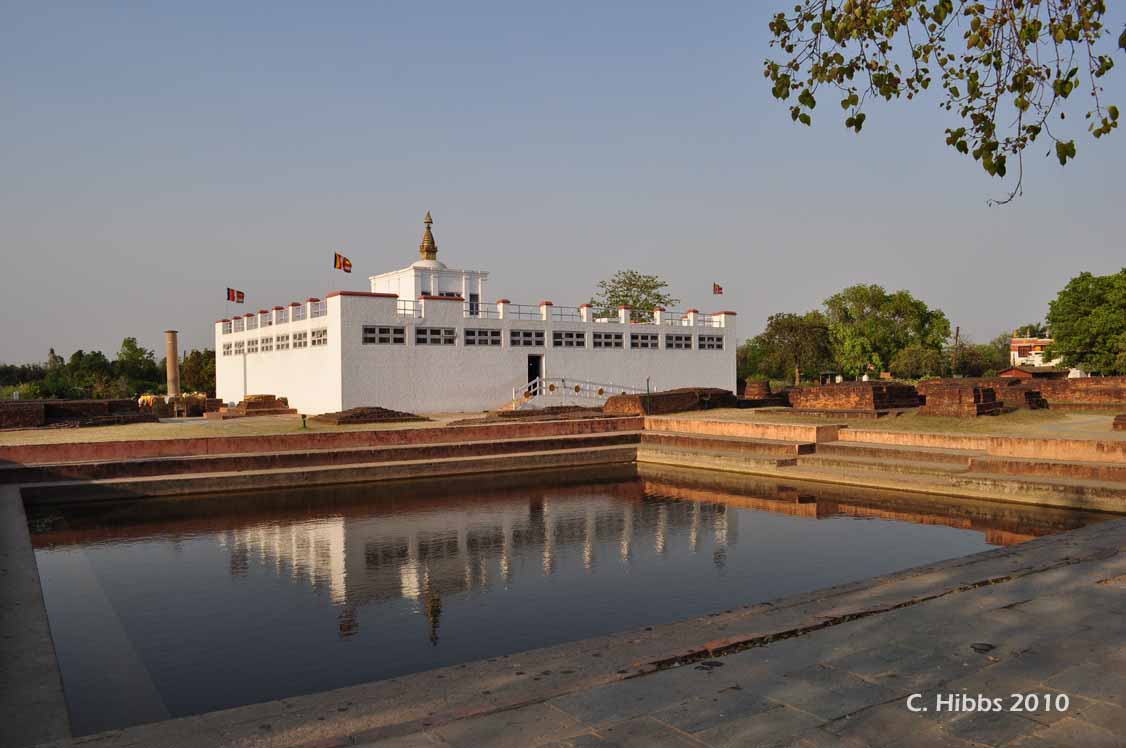
The Buddha was born in Lumbini in the 6th century BCE, a prince named Siddharta Gautama. Now Lumbini is in Nepal, near the border with India. The Maya Devi temple, named after his mother, was built on the location, and is now surrounded by monastery ruins, prayer flags, and modern monasteries built by pilgrims from around the world. In the 2nd century BCE, Emperor Ashoka, who is the reason for the spread of Buddhism around the world, made a pilgrimage here and left one of his famous columns.

Lumbini was also the site of one of my worst travel experiences ever, when I caught someone watching through the bathroom vent while I was showering. I'm sure he was working there, or had some relationship with the staff, although the managers all denied knowing who he was. Obviously, after shouting at the managers for a while, I stormed out to another hotel. Lumbini Guest House: Do Not Stay!


Bodhgaya is the holiest pilgrimage site for Buddhists, because this is where the Buddha achieved enlightenment, or nirvana, while sitting in meditation underneath a bodhi tree. A descendant of that tree is in front of the Mahabodhi Temple in the photo. Surrounding the temple are numerous votive stupas built by pilgrims. Many of them are made of rubble of ruined stupas, with no apparent interest in putting puzzle pieces in order. Ashoka visited here too, and built an arch. Bodhgaya also has a huge Buddha statue, where I scorched my feet on a very brief attempt to approach the statue properly barefoot. The people who constructed the walkways in Bodhnath were definitely not thinking: red sandstone gets really hot in the sun, and even white marble is too uncomfortable. Black marble = egg-frying (or foot-frying) hot! I also attended a zazen session here--sitting meditation in the Japanese Zen Buddhist tradition.


Sarnath, where the Buddha began to teach the Middle Way, is filled with gorgeous monastery ruins, the ruins of the huge Dhamekh Stupa with unique carvings, another Ashokan column, and a temple built by a Sri Lankan pilgrim, with lovely frescoes by Japanese artist Kosetsu Nosi. The archaeology museum here holds the famous Ashokan lion capital, now a symbol of India on all paper currency. The sculpture stands alone in craft and preservation; aside from a broken jaw on one lion, and other minor bumps, it looks like it was carved last week. I was also fascinated with a large sculpture of a parasol--important in Buddhist symbolism--but other visitors to the museum seemed much more fascinated with the foreigner.

The Buddha took mahaparinirvana (the great final nirvana)

in Kushinagar, when he was an old man. A person can achieve nirvana, or escape from suffering, during her life; someone who dies in this state achieves parinirvana, and escapes from the cycle of rebirths. As far as I know, only the Buddha claims mahaparinirvana. A stupa was built on the site, and a temple to house the 5th century CE statue, carved from red sandstone, and now covered in gold leaf by pilgrims. Here also are the ruins of a huge stupa, and a temple built on the site of the Buddha's last sermon.


All of these sites were windy, dry, dusty, and hot--around 40 to 45 Celsius. While traveling around by bus, train, and foot, the parched landscape caused me some deep anxiety. I wonder if this was a completely unfamiliar landscape to me, having grown up in the middle of vast amounts of water in the Canadian Great Lakes, when two weeks without rain is considered "dry." Or perhaps this was some other deeper fear of the famine that is often associated with such a landscape. I've included photos of the dust blowing across the road, and the necessity of covering up from the sun and blowing dust. No, I don't look like a "terrorist," I look like someone trying to keep cool, and to keep dust out of my mouth, nose, and ears. It seems counterproductive, but covering yourself from the sun in such a heat makes a big difference. Drinking 4 litres of water a day also helps.

Sunday, April 11, 2010

Around Kathmandu, and Pokara

I'm looking back to last week for this post, but I wanted to add a short note about right now. It is 40-45 degrees during the day right now, which is REALLY REALLY hot!! I've found it interesting that when it gets so hot, I better cover up. I generally don't go outside without covering my head, and I'm sorry that I didn't bring a long-sleeved cotton shirt.

My last few days in Kathmandu I spent visiting the areas outside the centre. Bodhnath (also known as Boudha) is yet another stupa said to contain a relic of the Buddha. I spent half the day wandering around visiting the monasteries and watching the pilgrims. One monk led me through a prayer in a monastery. For a while, I also watched a nun prostrating herself around the circumfrence of the stupa. I also tried Tibetan tea, which is made with yak butter.


From there I made my way to a tiny village which has a beautiful Vajrayogini temple. On the climb I met a god coming down the mountain, carried by people living there. Just as I got to the top it started to rain and thunder, which was great because I had been missing rain and thunderstorms, but not so great for photos. I also had some time where I thought I might get soaked getting back down the mountain in time for the last bus.


The next day I visited Patan, and was very impressed with its Durbar Square. I've included a photo where you can see King Yoganarendra's statue on a pillar in the centre, which is over 300 years old. This square was much quieter than the one in Kathmandu proper, because traffic was blocked, and there were no markets set up.


On a walking tour around Patan I came upon a festival at the Kumbeshwar Temple, which has five storeys. I'm not sure what was going on, but almost all the women were dressed in red saris, and the focus was on teenage boys dressed in yellow, with shaven heads and decorated bow and arrows. I watched them go through several stages of puja.

The Buddhist Golden Temple was filled with beautiful icons, and you can see more photos in the Facebook B-list. Nepali temples are strikingly different from Indian temples. They are usually built with pagodas, and I saw as many as 5 tiers on the roof. They also have a metal banner laying down one side, which I don't know the meaning of, and I definitely intend to learn more about this style of religious architecture!


Pokhara is a much smaller and MUCH quieter tourist town, where many people begin a trek to the Annapurna range in the Himalayas. Due to a lack of time and a still-healing ankle, I only did short walks around the hills. On the hike to the World Peace Pagoda I grabbed the first foreigner I saw, so I wouldn't have to walk alone. He happened to be a really cool American named Ben, and I don't think we ever ran out of things to talk about. First, Devi's Falls, with some amazing erosion, but not such an amazing amount of water. I'm really starting to see the effect of the summer dry season. I was somewhat disappointed with the World Peace Pagoda. I hear it has some really great views of the Annapurnas, but the haze/pollution really got in the way of seeing anything.

Finding Ben to split the cost of an early morning (five am) taxi made it worthwhile to go up into the mountains to Sarangkot, where there are legendary views of the sunrise in the mountains. That day there was a running commentary from a stout German man to everyone within range, so there was no doubt when the sun rose over the mountains. It was amazing to see Macchupucchre, the most distinctive peak in the range, looming through the early morning glow. It shook me repeatedly to realize that when I looked for the peak, I always needed to look higher. Then, the best yet. After a small breakfast on the mountain, we decided to go back for one more look, and there were the mountains! It continued to get clearer for the next hour, but it was impossible to capture on film. The mountains actually fill the sky.


The hike back down was nearly as interesting, because we decided to disregard the locals' advice that we "wouldn't find the path" and spent some time wandering through the terraced fields, and eventually walking down a dry stony riverbed. That afternoon we visited one of the Tibetan refugee settlements, and watched young monks at the monastery sit through a ceremony with various levels of boredom. Finally, since the local public transportation is not designed for tourists (ie. non-existent for tourists), we hitched a ride back into town on a tractor. That got us plenty of smiles from the locals we passed!

Wednesday, March 31, 2010

Kathmandu

My exodus from India went as planned, but that meant about 30 hours on the road, from my front door to the hotel in Kathmandu. That meant a flight from Pune to Delhi, a layover in Delhi before a flight to Patna. From Patna I caught an overnight bus to the India-Nepal border almost right away, on which I bruised my head falling asleep against the window. The last leg of the trip from Raxaul/Birganj to Kathmandu was the most difficult. I took a cramped jeep over six hours of bone-bruising, joint-cracking, muscle-pounding bumpy roads through the mountains. After already being tired from travelling for 24 hours, it completely exhausted me. The gorgeous views of the mountains and valleys barely made up for it. Obviously I took the afternoon to recover and get a sense of the city.

Here I got to know my new camera, which meant, of course, a bunch of overexposed photos. I didn't lose anything serious, and once I figured it out, got a few great shots that wouldn't be possible with my old point-and-shoot. I started on a walking tour south of the tourist area in Thamel to the main historic area Durbar square. Buddhism in Nepal comes from a different stream than Indian Buddhism, from the Vajrayana, or Tibetan, school. Most people are familiar with the Dalai Lama; this is the school of Buddhism to which he belongs. Often Hindus and Buddhists will pray at the same temple. It was fascinating to see how the features of the gods changed in a different culture; people certainly create god in their own image! In Nepal, porters carry incredibly huge loads. Shortly after I took this photo, this man put this package -- which looked as if it must be filled with rocks -- onto his back and carried it down the street.

I spent a lot of time at the Seto Machendranath Temple, which is a large temple covered in gold-coloured metal decoration, has prayer wheels around the walls and wooden carvings in the roof supports. Many small stupas fill the square around it, and several beautiful statues of the gods. I've included here a photo of the two Taras, who are Buddhist Goddesses. I found it somewhat annoying that the square was also filled with pigeons, so it was difficult to take a photo without including them.

Durbar Square is the main historical centre, with temples dating back to the 12th century. One of my favourites was the Shiva-Parvati temple, where the holy couple peer out of the top window. I was also very excited to be able to see Kumari Devi, the living goddess of Nepal, who lives in a house with beautifully carved wooden windows. Wood carvings are used in Nepal much more often than in India, where most of the carvings are stone. Photos of the Kumari are not allowed, but photos of her courtyard are.


Early one morning I visited Swayambhunath, the site of one of the most important stupas in the Kathmandu Valley. Pilgrims were circling the stupa and spinning the prayer wheels, or standing in line to visit the goddess Hariti. There is an important gompa here as well, with a huge golden statue of Sakyamuni Buddha. Prayer wheels come in all sizes, but these children were playing around -- I don't think it really took both of them to turn the wheel! The stupa platform and the surrounding Tibetan settlements are filled with prayer flags as well as with prayer wheels. Each flag has a prayer printed on it, and every time the wind blows it, it sends the prayer. Likewise, every prayer wheel has a mantra on it, and every time a pilgrim spins the wheel, it sends the prayer. Before I left I circled the stupa to spin the prayer wheels.

On another tour of the city I found children climbing on and residents praying at a huge chariot! These chariots are built for festivals and are incredibly tall. I didn't see them move it, but I can't imagine how it doesn't fall over when they roll it around the city. (Or how they maneuver around the knots of electrical wires that seem to fill every intersection.)

Finally, the good news is that the quarrel with India is reconciled, although I think that government officials will always be ready to remind me of the fight for the rest of the year, if not the remainder of my passport, if I ever return to India in the coming years. So I'll be heading back into India in a week or two, to make the long trip back to Pune.

Tuesday, March 23, 2010

Delhi and Amritsar

Funny, I'm posting from Delhi on a stopover on my way to Nepal! I was here less than a week ago! I spent some time shopping for books at the Jahawarlal Nehru University with a friend's boyfriend, Ankush. (If anyone knows where I can get a copy of the Therigathas -- preferably in Nepal, I would really appreciate it!) Then we visited Qutb Minar, a tower planned by the first Muslim Indian ruler Qutb-ud-din Aibak, I was amazed with the intricate carvings, and I'll probably go back some day just to take some photos in different lighting. The surrounding complex was built from the rubble of Hindu and Jain temples that were originally on the site, continuing the age-old culture-wide tradition of knocking other people's buildings down to build your own on top. The shorter unfinished tower was meant to be taller, but they just couldn't get it up.

The next few days I spent sick in bed, with a brief and traumatizing train trip to Amritsar because I bought my ticket before I got sick. I was lucky to stay at Hotel Grace, where the owners were incredibly friendly, checked up on me regularly, and even made me a snack once! Basically I lived on biscuits and water for almost five days.

Once I recovered I took the short trip to the Pakistani border to watch the border closing ceremony at the only land crossing between the two countries. It was fascinating! It's a combination of pep rally -- including a dance party with Bollywood tunes -- and choreographed border guard demonstration.

I also visited Jallianwala Bagh, the walled park where British soldiers fired without warning on a peaceful demonstration and killed hundreds of people. The park is a beautiful but sad monument to the tragedy. I've included a photo of the Martyrs' Well; people jumped into the well trying to escape the bullets.

Lal Devi Temple was one of the more memorable Hindu temples I've visited. It's like a funhouse! You climb up and down ramps and stairs, cross over bridges, crawl through passageways, and double back on the path. There's a rack of bells that everyone loves to ring, and some of the passageways are tiled in mirrors. Through one passageway you even walk through ankle-deep water, which delighted me and more than one child. After the fun, I sat for a while to listen to women singing devotional music to the saint.

Finally, the best part of Amritsar: The Golden Temple is the holiest site for the Sikh religion, and I spent almost a whole day there. Sikhism is known in the west for the turbans Sikh men wear to keep their uncut hair tidy, and for the kirpans, the ceremonial daggers which are rarely functional weapons, but often controversial. Uncut hair and the ceremonial dagger are two of the five symbols of the Sikh brotherhood; the others are a comb, undershorts, and a steel bracelet. The turban is a cultural, rather than a religious symbol, and women rarely wear it.

I found the people here very welcoming, and everyone must remove their shoes and cover their hair. The temple also includes a langar, or community kitchen, where anyone can eat for free. The traditional guards, Sardars, are both friendly and intimidating. While I'm still taller than average, in Amritsar I didn't feel quite as monstrous as usual, since the Punjab region is known for tall men and women.

I stood in line for about 45 minutes to pray in the gurdwara, take some prohibited photographs on the roof, and listen to Sikh men singing devotional songs and recite the Guru Granth Sahib, the Sikh holy book, which is also the living guru. Finally, I sat and watched the sunset from the marble walkway around the pool. As usual, I took many photos, which you can find if you access Facebook. At sime I'm looking forward to taking even more photos with my new DSLR camera, on which I blew an entire month's budget yesterday.

Sunday, March 21, 2010

Delhi: The Old City

I haven't posted a blog for some time, mostly because India has been kicking my butt for the past six weeks. Let's just say that I was in a six-week whirlwind relationship with bureaucracy, and they decided they didn't want to see me anymore. So I'm leaving Pune for Kathmandu, Nepal on Tuesday morning, for a few weeks. On top of that I sprained my ankle badly, and then I ended up with some sort of stomach bug that knocked me down for almost five days.

The good news is I went to Delhi, and I took hundreds of photos! I started out at the Red Fort (Lal Qila), but the lineup was huge so I decided to return another day. From there I walked to Raj Ghat, where Gandhi was cremated. The words on the front translate roughly to "Oh God," Gandhi's last words when he was assassinated by a Hindu fanatic.

The Jama Masjid was the next visit, and I was surprised to find it the first religious site where I didn't feel welcome. (I suspect that comes from being a woman travelling alone, in the conservative Old City of Delhi.) The mosque is beautiful though, following the red sandstone and white marble theme of many of the historical buildings in Delhi. A short stop at the India Gate, commemorating Indian soldiers, and a brief look at the Parliament buildings, which are mostly enclosed by high walls.


Back to the Red Fort to spend half a day wandering around the old buildings. The immense outer walls are built of red sandstone, and most of the inner buildings are white marble. The Mughal emperor Akbar had a personal mosque built here. Many of the buildings had pietra dura, or semi-precious stone inlaid in the marble. Where water meant wealth (and still does, to some extent), it was incredible to see the complex of fountains and waterways, and to imagine the display of power it represented. Although most of the waterways are dry now, the wealth is still displayed in the green lawns.

A short stop for Old Dehli's famous jalebis, then onward. I planned to visit the Taj Mahal in Agra on this visit, but "Delhi belly" stopped me. I did manage to complete the other "bookend" to the Taj Mahal; in Aurangabad I visited Bibi ka Maqbara, built by the Mughal emperor Aurangzeb and influenced by the Taj Mahal, and in Delhi I visited Humayan's Tomb, built by the wife of the Mughal emperor Humayan, and a precursor to the Taj Mahal.

Stay tuned for Part II of my north-western Indian adventures!